Selection guide
Choosing the right G-Series gearbox for your application
Selecting the right gearbox comes down to four things: what the application demands, the space you have, the motor you are using and the ratio that gets you to the right speed.
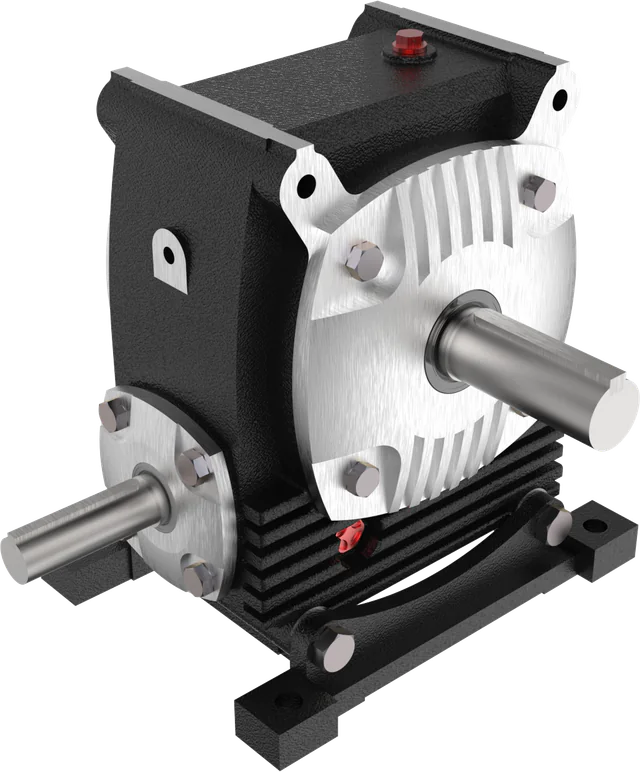
Selecting the right gearbox is crucial for performance and efficiency. A unit that is too small runs hot and wears early. One that is too large costs more than it needs to and takes up space the machine may not have. Here are the factors to work through when choosing from the Gishnu G-Series.
1. Start with the application requirements
Determine the specific demands of your application: speed, torque and load. Two numbers do most of the work.
Output speed is the motor speed divided by the gearbox ratio. A 1,440 rpm motor on a 30:1 gearbox gives 48 rpm at the output shaft.
Output torque follows from power and speed. As a first estimate:
Torque (Nm) = 9,550 × power (kW) × efficiency ÷ output speed (rpm)
One horsepower is about 0.746 kW. So a 2 HP motor (1.5 kW) driving that 48 rpm output delivers roughly 300 Nm before gearbox losses are taken into account. Efficiency depends on the ratio and size of the unit, so treat this as a starting figure and confirm the rated torque for the model you choose.
2. Allow for how the machine actually runs
The same torque is not the same duty. A conveyor carrying a steady load for eight hours is kinder to a gearbox than a grinder that starts under load many times an hour. Note down:
- whether the load is uniform or comes with shocks,
- how many hours a day the drive runs,
- how often it starts and stops.
These decide the service factor applied when the size is chosen. Heavier or more frequent shock loading calls for a larger unit than the bare torque figure suggests.
3. Check the space you have
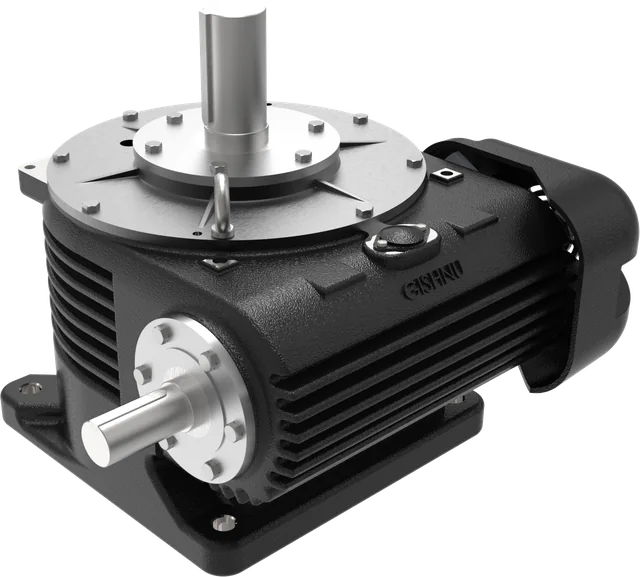
Consider the available space for installation, and where the shafts need to be. The G-Series comes in two types: GU, in sizes 162 to 337, and GV, in sizes 400 to 900. Measure the envelope on the machine, the position of the driven shaft and the access you will need for the oil filler and drain.
4. Match the motor
Select a gearbox that is compatible with your existing motor, or with the motor upgrade you are planning. The G-Series covers motor options from 0.5 to 30 HP. Have the motor power, speed and mounting details to hand so the input can be matched correctly.
5. Select the ratio
Choose the ratio that gives the output speed and torque you worked out in step one. G-Series ratios run from 5 to 70. If the speed you need falls outside that range, or the drive has to be in line rather than at a right angle, look at the GAL-Series (ratios 5 to 100) or the H-Series inline helical geared motors (ratios 5 to 120).
What to send us with an enquiry
If you would like our engineers to make the selection, these details let us answer quickly:
- the machine or application the gearbox will drive,
- motor power and speed,
- required output speed or ratio,
- running hours per day and the nature of the load,
- mounting position and any space limits,
- quantity required.
Where no standard unit fits, the requirement can be taken up as a custom-built M-Series gearbox.